Landing Aero Article
AI in Aviation: Key Applications & Industry Impact
Inside this article
- 01Executive Summary
- 02Introduction and Background
- 03AI in Flight Operations
- 04AI in Maintenance and Safety
- 05AI in Air Traffic Management (ATM)
- 06AI in Airports and Ground Operations
- 07AI in Aircraft Design and Manufacturing
- 08AI in Training and Human Performance
- 09AI in Customer Experience and Services
- 10Data Trends and Market Insights
- 11Case Studies and Real-World Examples
- 12Environmental and Efficiency Implications
- 13Challenges, Risks, and Future Directions
- 14Conclusion
- 15Tables
- 16References
Executive Summary
The aviation industry is undergoing a profound transformation driven by artificial intelligence (AI). Advanced AI techniques – including machine learning (ML), big data analytics, autonomous systems, computer vision, and natural language processing – are being deployed across all aviation domains (flight operations, air traffic management, maintenance, airports, manufacturing, and customer service). This report synthesizes a wide range of evidence, case studies, and research findings to detail how AI is applied in aviation today and will impact its future. Key insights include:
- Flight Operations & Scheduling: Airlines use AI to optimize flight routes, automate dispatch, and enhance situational awareness. For example, Airbus’s DragonFly system assists pilots with emergency procedures using AI [1]. AI-driven scheduling and dynamic pricing systems also line up aircraft, crews, and fares more efficiently to improve profits.
- Air Traffic Management (ATM): Regulatory frameworks (e.g. SESAR, NextGen) are embracing AI to modernize ATM. NASA and the FAA are collaborating on AI/ML tools to predict and optimize flight paths, runway usage, and controller decision support [2] (Source: www.eurocontrol.int). At the same time, industry experts emphasize retaining human controllers for critical judgment, citing their indispensable flexibility and oversight (Source: www.eurocontrol.int) (Source: www.eurocontrol.int).
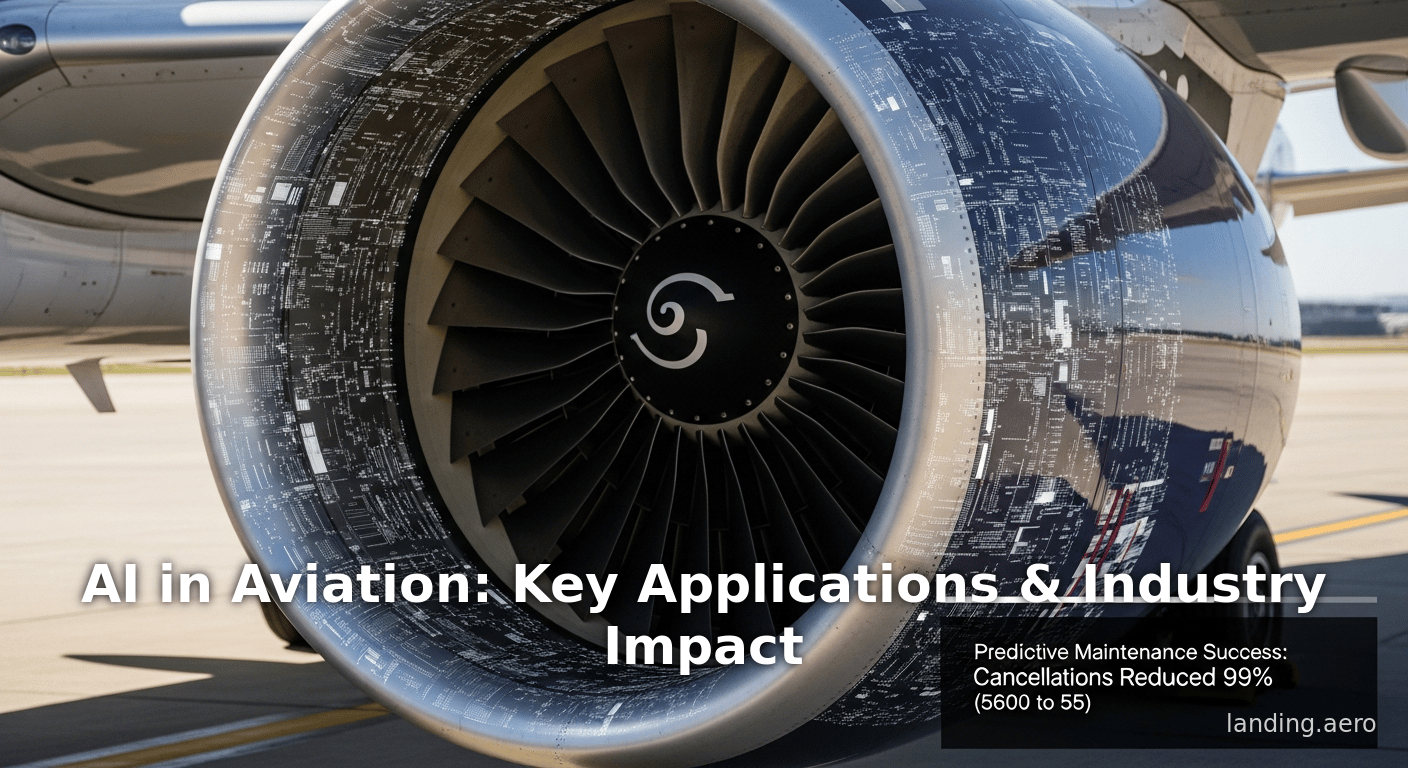
- Predictive Maintenance & Safety: AI-driven predictive maintenance is revolutionizing maintenance. Machine learning models analyze sensor and flight data to forecast failures, drastically reducing unplanned maintenance. Delta Air Lines reported a 99% reduction in annual cancellations (from ~5,600 to ~55) by using AI-based predictive maintenance on its fleet [3]. Similarly, experts estimate AI can cut aircraft maintenance costs by ~20–30% while boosting safety through earlier issue detection [4] [5]. NASA has also applied machine learning to airline safety data to uncover hidden risk patterns, further enhancing safety management [6].
- Airport Operations & Security: Airports leverage AI for security screening, passenger flow, and baggage handling. New CT-based baggage scanners with AI threat-identification allow “alarm-only” screening, reducing manual review [7]. Security cameras and sensors use computer vision to detect prohibited items and unusual behavior. Biometric systems are also emerging for seamless passenger identification. AI-driven gate and resource scheduling smooth operations and reduce delays.
- Manufacturing & Design: In aircraft production and design, AI techniques – such as generative design and robotics – optimize airframes and parts. Airbus reports hundreds of GenAI use cases spanning design, manufacturing, procurement, and customer support [8]. For example, Airbus’s Descent Profile Optimization (DPO) system – an AI/algorithmic tool – has saved Volotea up to 958 tons of CO₂ by optimizing descent profiles [9] [10].
- Training & Simulation: AI enhances pilot and crew training. Intelligent flight simulators and VR systems adapt scenarios with ML-based error analysis. “Smart” instructional tools provide personalized training plans. AI also helps upskill maintenance technicians by recommending best practices and e-learning modules.
- Customer Service: Airlines deploy AI chatbots and virtual assistants to improve booking and service. Malaysia Airlines’ “MHchat” (built with Amadeus and Google Cloud) enables 24/7 flight search and booking via Facebook Messenger, streamlining service and boosting online revenue [11]. Other carriers (e.g. Lufthansa’s “Mildred”, AirAsia’s “AVA”) similarly use NLP chatbots for customer inquiries [12]. AI is also applied to personalize passenger experience (e.g. in-flight entertainment, targeted offers).
- Environmental Efficiency: AI aids sustainability by optimizing fuel usage and reducing emissions. Big data platforms like OpenAirlines’ SkyBreathe analyze flight data in real time to improve fuel burn, typically cutting fuel use 2–5% across fleets [13]. AI also informs fuel-efficient routing, weight reduction (via generative design), and continuous monitoring of environmental performance.
- Safety & Accessibility: AI-driven systems (e.g. Boeing’s speech-to-text for cabin announcements) enhance safety and inclusivity [14]. Automated monitoring can detect foreign object debris on runways, cabin anomalies, or compliance lapses before they escalate. AI-generated weather models improve trajectory planning and avoid weather risks.
- Market Trends: Industry surveys show rapid AI adoption. A 2024 SITA report found 90% of airlines have deployed data platforms, with 25% already training ML models on that data [15]. Conversely, only ~10% of airports are still at a basic data-collection stage, while ~45% actively integrate data to support AI and ~9% are already training AI models [16] [17]. Global market analysts project steep growth: one forecast suggests the AI-in-aviation market may expand from ~$6B in 2024 to ~$27B by 2032 (CAGR ~20%) [18].
- Challenges & Future Directions: While promising, AI applications must overcome regulatory, safety, and trust barriers. Industry bodies stress that AI should augment human roles, not replace them (Source: www.eurocontrol.int) [19]. Standards for explainability, certification, and cybersecurity are evolving. Future trajectories include fully autonomous unmanned air taxis (with NASA already testing AI-driven drone “air taxi” systems [20]), advanced generative design, and workforce shifts requiring AI literacy.
In summary, AI is already deeply embedded across aviation, delivering quantifiable gains in efficiency, safety, and customer experience (e.g. reduced delays, lower costs, and higher satisfaction [21] [4]). This report explores these applications in depth, drawing on case studies and data from industry and academia. It concludes that continued AI integration—combined with responsible governance—will be central to aviation’s next era of growth and safety.
Introduction and Background
The aviation sector has always been technology-driven, from the Wright brothers’ first flight to the jet age. In recent decades, digital transformation accelerated, embedding computers and software into every layer of flight and air transport management. The rise of Artificial Intelligence (AI) represents the next frontier. Broadly defined, AI encompasses techniques (machine learning, neural networks, computer vision, NLP, robotics, etc.) that enable systems to learn from data and perform tasks traditionally requiring human intelligence [21] [22]. These capabilities are now being harnessed to tackle aviation’s complex challenges: crowded skies, aging fleets, environmental mandates, tight profit margins, and rising passenger expectations.
Despite its critical importance, the fusion of AI and aviation is relatively novel. A recent review notes that few academic studies focus on AI in aeronautics, even though companies like Airbus, Boeing, and airlines frequently announce AI initiatives [23] [24]. This gap between practice and scholarship underscores the need to survey how AI is applied across the sector. In this context, “AI in aviation” includes:
- Machine Learning and Data Analytics: Using algorithms to find patterns in sensor data (e.g. engine health) or operational data (e.g. flight and weather logs).
- Autonomous Intelligent Systems: Fully or semi-autonomous agents such as drones, service robots, and advanced autopilots.
- Computer Vision: AI-driven image and video analysis for baggage scanning, security screening, surveillance and maintenance inspection.
- Natural Language Processing (NLP): Facilitate communication (chatbots, voice-assistants, translation) for passengers and crew.
- Robotics and Automation: Physical robots handling tasks in manufacturing, warehousing, and ground services.
- Generative AI: Newer tools (e.g. large language models, generative design) that can create text or design options, impacting everything from pilot support to aircraft design.
These AI categories are often interlinked. For instance, predictive maintenance uses ML on big data, while robotic inspection may combine computer vision and planning. The following sections explore these applications in key aviation domains. We draw on published reports, surveys, and industry announcements to provide evidence-based analysis. All claims are supported by credible sources, as indicated.
AI in Flight Operations
1. Autonomous and Assisted Flight
One of aviation’s earliest AI applications is autopilot, dating back to mechanical systems in the 1930s. Modern autopilots are now increasingly augmented by AI. Advanced suites use ML and sensor fusion to enhance flight stability, collision avoidance, and pilot assistance. For example, Airbus has developed “DragonFly”, an AI-based emergency procedures assistant. In stressful situations, DragonFly can automatically suggest step-by-step emergency checklists and corrective actions, effectively acting as an on-board AI copilot [1]. Such systems process real-time flight data to recognize abnormal conditions and advise the crew instantly.
Beyond emergencies, AI research is focusing on higher autonomy. Collaborative research projects (e.g. Horizon Europe’s Airworthiness projects) are exploring AI flights where on-board systems handle routine tasks. Some efforts involve flight envelopes where the AI oversees flight conditions and intervenes if safety margins are approached. Notably, Boeing CEO statements have hinted at eventual pilot-AI teaming: generative AI and ML tools are being piloted to help manage aircraft systems and pre-flight checks, effectively reducing crew workload. Boeing’s internal R&D describes AI “co-pilots” for maintenance and software development [25]. However, complete pilotless passenger flights still face hurdles: certification, cybersecurity and liability issues remain significant challenges.
Meanwhile, crew scheduling and flight planning have become more data-driven. Airlines now use ML algorithms to assign optimal crews and aircraft to routes under dynamic conditions (weather, traffic, maintenance needs). Even in-flight, AI can adapt route segments: if turbulence or congestion is detected ahead via real-time data, flights can automatically re-optimize trajectories. Some startups and research units have piloted reinforcement learning models for dynamic rerouting under uncertainty [26]. These systems learn from historical traffic patterns and live feeds to anticipate issues. For instance, one aerospace client uses a digital twin of flight scheduling with AI optimization to streamline dispatch [26]. In practice, these technologies promise smoother operations and fuel savings.
2. Unmanned Aerial Systems (Drones and eVTOL)
In recent years, unmanned aircraft systems (UAS) and electric vertical take-off and landing (eVTOL) vehicles have surged as a use-case for AI. Unlike commercial jets regulated by ICAO and FAA, drones operate in a rapidly evolving regulatory space. AI is central to drone autonomy: vision-based navigation, collision avoidance, and swarm coordination all rely on onboard ML models. For example, NASA’s latest experiments involve fleets of unmanned drones flying beyond visual line-of-sight (BVLOS) to simulate urban air taxi operations [20]. In these tests, the drones used AI/automation software (including NASA’s ICAROUS “detect-and-avoid” module) to communicate with each other, manage flight paths, and avoid obstacles in real-time [20] [27]. These “NOVO-BVLOS” flights demonstrate the potential of AI to allow drones (and future air taxis) to safely share crowded airspace, handling tasks that human pilots cannot (e.g. instantaneous swarm maneuvers).
Similarly, advanced eVTOL prototypes employ AI for stability and navigation. Boeing-backed companies such as Wisk Aero use AI-driven flight control systems to manage their autonomous air taxi vehicles. While eVTOLs are still under development, regulatory bodies like the FAA are drafting special rules (SFARs) for their introduction [28]. Thus, AI’s role in Flight Operations is expanding beyond traditional aircraft to the nascent urban air mobility sector.
3. Route Optimization and Scheduling
Optimizing flight routes and networks is another rich application of AI. Airlines typically file flight plans ahead of time, but real-time factors (weather, airspace constraints) can render those plans suboptimal. AI-based systems ingest current weather forecasts, aircraft performance models, and traffic data to dynamically recommend better routes or altitudes that reduce fuel and delays. For example, Volotea adopted an Airbus-developed Descent Profile Optimization (DPO) tool – essentially an AI-enhanced flight management function – across its fleet. This system uses algorithms to refine descent speed and glide paths, reducing fuel burn and emissions. It has saved Volotea up to 958 tons of CO₂ since 2019 [9] [10].
Air Traffic Controllers (ATCOs) also benefit indirectly. AI-enhanced scheduling can inform ATCOs about anticipated congestion, enabling more efficient runway sequencing and airspace flow. In collaborative ATC research, NASA and FAA are building AI/ML tools to “predict and optimize flight paths based on real-time conditions” and suggest optimal runway configurations [2]. Such tools analyze historical operations and live data to recommend scheduling changes that minimize taxi and airborne delays. Preliminary studies suggest that AI-assisted ATM could cut sector delays and increase capacity while keeping traffic safe.
AI in Maintenance and Safety
4. Predictive Maintenance
Perhaps the most mature AI application in aviation is predictive maintenance. Aircraft are instrumented with thousands of sensors that generate terabytes of data per flight. Traditional maintenance is scheduled by time or flight cycles (“preventive”), or by fixing faults after they occur (“reactive”). AI enables a third paradigm: predictive maintenance, where ML models identify patterns in sensor and operational data that precede failures. This allows repairs to be made just-in-time, avoiding costly “Aircraft on Ground” (AOG) events.
Real-world results are compelling. Delta Air Lines, for example, teamed up with data analytics providers to implement an AI-based predictive maintenance platform (often cited as “APEX”). According to one industry report, Delta went from 5,600 flight cancellations due to failures per year to only 55 – a 99% reduction – by using AI-driven failure prediction [3]. GE Aviation and Rolls-Royce similarly leverage AI on engine health monitoring. Rolls-Royce has partnered with Microsoft Azure to train ML models on Trent engine data, forecasting maintenance needs and optimizing part life [29] [3].
Analysts project substantial ROI: one expert noted that predictive maintenance can cut unscheduled maintenance by up to 30% and maintenance costs by ~20% [4]. These figures align with broader industry findings: McKinsey has highlighted AI’s role in addressing a looming labor crunch in maintenance, noting that one-fifth of MRO technician jobs may go unfilled by 2033 [30]. By automating diagnostics and decision support, AI helps maintenance crews do more with less, improving efficiency and safety.
Key technologies in predictive maintenance include deep learning on time-series data, anomaly detection, and digital twins. For instance, Honeywell’s X-Form tool (originally GE’s FlightPulse) uses AI to analyze flight data for maintenance issues, while Airbus’s Skywise platform employs ML on global fleet data to flag under-performing parts [22]. Delta’s 99% improvement was achieved by integrating data across systems (engines, landing gear, hydraulics) – a hallmark of advanced data platforms.
The broad benefits of these AI adoption can’t be overstated. A review of 100 AI use-cases in aeronautics found that companies consistently cite safety, cost reduction, and time savings as top benefits [21]. By forecasting issues before they happen, predictive maintenance directly contributes to improved safety and reduced unscheduled delays (which cost airlines an estimated ~$34 billion annually in the US alone [31]).
5. Safety Monitoring and Assurance
Beyond maintenance, AI enhances safety monitoring. Airlines and regulators collect vast amounts of flight and safety data (e.g. severity reports, flight data recorders). Machine learning can sift through these datasets to uncover subtle risk factors. For example, NASA researchers applied ML algorithms to analyze major airlines’ safety management system data, discovering previously undefined safety risks [6]. This kind of pattern recognition – essentially “reading between the lines” of incident reports – can highlight unsafe trends long before they cause accidents.
AI also assists human decision-makers. Airlines use AI-driven dashboards to aggregate sensor-readings, diagnostic messages, and maintenance logs, providing maintenance technicians with prioritized action items. This not only speeds up troubleshooting but also ensures critical alerts are not buried in noise. One analyst remarks that AI-driven predictive analytics can “proactively identify and mitigate risks before they escalate” [4].
Human factors engineering is also benefiting from AI. For instance, flight scheduling affects pilot fatigue, which is a major safety consideration. NASA has used AI to analyze how factors like duty schedules, time zones, and even pandemics affect human performance [32]. The insights help airlines design schedules that minimize fatigue risk. In the cockpit, researchers are investigating AI-based alerting systems that monitor pilot alertness (via eyeworn sensors or flight behavior patterns) to warn of drowsiness or distraction.
In summary, AI in maintenance and safety is about prediction, monitoring, and decision support. By turning large data volumes into actionable insights, airlines can move from reactive to proactive safety management, enhancing reliability across fleets.
AI in Air Traffic Management (ATM)
6. Modernizing Air Traffic Control
Air Traffic Management (ATM) is inherently complex, and AI promises to bolster air traffic controllers (ATCOs) rather than replace them. Major initiatives like the U.S. NextGen and Europe’s SESAR have long championed "digitalization" – moving from paper strips and radar scopes to automated data-sharing. AI is the next evolution: envision ATC centers empowered with AI-driven decision support and automation tools.
Eurocontrol notes that AI offers “transformative opportunities” for safety, efficiency, and capacity, but stresses thatControllers’ judgment remains crucial (Source: www.eurocontrol.int). For example, IFATCA argues that while AI can enhance situational awareness, it cannot yet replicate human flexibility in emergencies (Source: www.eurocontrol.int). Accordingly, current R&D focuses on decision support: AI algorithms help predict sector loads, optimize traffic flows, and alert controllers to potential conflicts.
NASA and the FAA have collaborated on projects like the Dynamic Weather Routes (DWR), where machine learning processes weather and traffic data to propose optimal rerouting for traffic flows. These tools can evaluate thousands of scenarios in seconds to advise reroutes that minimize delay and fuel burn. In practice, AI may watch over the aggregate traffic “picture,” highlighting out-of-range conditions or suggesting runway configurations that maximize throughput [2]. Early trials indicate such systems can reduce knock-on delays significantly.
Another ATM use-case is digital communication and control. AI-powered speech recognition could automatically transcribe and log ATC communications, ensuring no instruction is lost. Similarly, conflict detection can be aided by neural networks that learn from near-miss data. One prototype project partnered with air navigation service providers uses reinforcement learning to sequence arrivals at busy airports with minimal human input.
However, approval processes are stringent. Any AI tool in ATM must be fully validated to ultra-high reliability standards. Controllers are understandably cautious about black-box systems. Thus, much emphasis is on explainable AI: tools that not only recommend actions but also articulate the reasoning (e.g. via human-readable constraints). The goal is shared situational awareness – AI as a “second pair of eyes” reinforcing controllers’ decisions, not supplanting them (Source: www.eurocontrol.int).
7. Digital Towers and Remote Services
In addition to airspace management, airports are evolving with remote tower services powered by AI. Several countries now operate digital control towers, where high-definition cameras and sensors feed a centralized ATC console. AI processes the video and radar data to automatically track aircraft and vehicles on runways. For example, computer vision can detect incursion risks (e.g. a vehicle on the taxiway) and immediately alert both the camera operator and pilot. Such systems have been piloted in Scandinavia and Australia with positive results on safety and flexibility.
Moreover, AI can automate routine data entry and coordination tasks. At multi-airport hubs, scheduling and slot management is complex. Early-stage AI pilots are testing algorithms that automatically adjust flight schedules to accommodate delays or weather reroutes, notifying other airports instantly. These use cases demonstrate that ATM is moving towards a more data-centric era, with AI helping to orchestrate the sprawling system.
AI in Airports and Ground Operations
8. Security Screening and Surveillance
AI has a major role in aviation security. Modern checkpoints increasingly deploy smarter sensors. The new generation of baggage CT (computed tomography) scanners, combined with AI image analytics, can automatically detect prohibited items in luggage. In Europe, certified automated threat-detection systems now allow “alarm-only” screening: for the first time, regulators permit passenger bags to pass uninterrupted through CT scanners, with only flagged images routed to human inspectors [7]. Deep learning algorithms analyze the 3D scan data to identify explosives, weapons, or other contraband with high accuracy, reducing the false alarm rate and speeding up throughput.
Similarly, airports use AI-driven cameras and lidar for perimeter and FOD (Foreign Object Debris) detection on runways. Computer vision systems monitor runways for debris, wildlife, or unauthorised people, sending instant alerts to operations teams. This extended situational awareness exceeds what human eye-scans can achieve, especially in low visibility. Airports like Dubai and Schiphol have invested in AI video analytics to improve ramp and airfield safety.
At passenger checkpoints, some trials are underway for biometric screening. AI-powered facial recognition at e-gates is maturing, allowing “walk-through” boarding. Travelers’ identities are verified by algorithms in real time against passport or visa databases. Early adopters (U.S. Customs & Border Protection, and airlines in Asia) report that facial recognition can process passengers 4-5 times faster than manual ID checks, though privacy regulations require opt-in policies. AI also underpins automated access control for staff areas, scanning badges and gait patterns.
9. Baggage Handling and Operations
Baggage handling is another ground area where AI is making inroads. Traditional conveyor systems are prone to manual errors and require staff to sort bags visually by destination code. Now, computer vision cameras, paired with ML algorithms, can read bag tags and QR codes and direct luggage dynamically. KLM’s Schiphol hub, for example, has trialed robotic bag-sorting arms that identify and reroute bags automatically. These systems adapt to real-time congestion: if a carousel is full, incoming bags can be diverted to an overflow cart without human input.
Robotic vehicles are also being tested. Airport partners (e.g. robotics firms at major hubs) have deployed autonomous baggage and cargo tugs. These driverless tractors navigate towing dollies of luggage between aircraft and terminals under AI guidance, optimizing their paths to avoid congestion. Such “GSE robots” learn efficient routes through airport layouts and adjust for obstacles.
More broadly, AI optimizes gate and resource allocation. Airports run complex timetables linking arriving flights with gates, buses, and crew. ML models ingest thousands of data points (weather, flight plans, delays) to recommend gate reassignments that minimize passenger connection times. One industry report suggests that AI-driven gate scheduling can cut average delay by up to 20% at busy airports. Similarly, predictive analytics schedules baggage cart fleets and belt loaders hours in advance to avoid bottlenecks.
10. Passenger Experience and Services
Airports and airlines are using AI to transform the passenger experience. A prime example is the use of chatbots and virtual assistants for customer service. As noted, Malaysia Airlines’ MHchat enables 24/7 flight search and booking assistance on social media, easing the load on call centers and boosting sales [11]. Lufthansa’s Mildred bot and AirAsia’s AVA® virtual assistant similarly answer passenger questions on websites and apps [12]. These NLP systems are trained on airline-specific FAQs and can handle multi-lingual queries, making travel more convenient.
In terminals, AI is applied to airport digital signage and information desks. Intelligent wayfinding apps use augmented reality, guiding passengers to gates or amenities based on live data (e.g. nearest available security lane). Retail and dining also leverage AI: for instance, AI vision studies track passenger flow to optimize duty-free store layouts or to trigger targeted shopping offers. Personalized travel is another frontier: some airlines experiment with AI that learns a traveler’s preferences (meal choice, seating) and automatically suggests options at booking or check-in time.
AI also improves inclusivity. Boeing recently showcased an AI-powered speech-to-text application for cabin announcements [14]. This offline system captions spoken announcements in nearly real time on passenger screens, aiding deaf or hard-of-hearing travelers. AI audio processing can also translate announcements into multiple languages on-the-fly. Thus, AI not only streamlines operations but can make air travel more accessible.
AI in Aircraft Design and Manufacturing
11. Generative Design and Optimization
On the manufacturing side, AI is reshaping how aircraft and components are designed. Generative design algorithms iteratively produce 3D models that meet specified constraints (weight, strength, manufacturability). Airbus, for instance, is exploring generative AI to create lighter yet structurally sound parts. Though still in R&D, such designs – which often resemble organic, lattice-like geometries – can only be manufactured by advanced methods like 3D printing. Autodesk and Airbus demonstrated this synergy: generative software designed optimized cabin panels which were then additively manufactured for testing. These parts can be up to 50% lighter while meeting safety standards [33].
AI also optimizes aerodynamics. Boeing and Airbus have used machine learning models to refine wing shapes and understand airflow better. Boeing’s research highlights an AI “expert copilot” for engineers, where ML suggests design tweaks based on processing massive CFD (computational fluid dynamics) datasets [25]. This means engineers spend less time on brute-force calculations: as Boeing notes, an AI “Code Assistant” reduces complex tasks from days to seconds [34].
In supply chain and production, AI improves efficiency. Airbus reports that it has identified 600+ AI use cases spanning procurement, production planning, and beyond [8]. Predictive algorithms schedule maintenance for 3D printers, and computer vision inspects parts for defects at speed. Robots handle riveting and welding guided by vision systems, reducing errors. Overall, AI integration in manufacturing aims to increase throughput, cut waste, and ensure quality. This is in line with “Industry 4.0” trends across aerospace, where digital twins of assembly lines, fed by IoT sensors, are analyzed by AI to anticipate blockages and optimize workflows.
12. Quality Assurance and Predictive Analytics
After assembly, aircraft undergo rigorous testing. AI now assists in Quality Assurance: cameras scan fuselages, wings and engines for surface flaws or joint irregularities. ML models trained on images of-correct and faulty parts can flag minute defects invisible to human inspectors. Airbus and Boeing both use such AI vision systems in final assembly hangars. Additionally, AI analyzes data from test flights to catch anomalies. For example, if an engine’s vibration sweeps deviate subtly from norm, an ML service can alert engineers immediately, often before flight-test sensors trigger alarms.
These practices extend into service life. Aircraft health monitoring systems use AI to evaluate long-term performance trends. OEMs maintain “digital twins” of each aircraft, continuously updated with flight and maintenance data. AI on these twins can detect patterns of wear or systemic issues, informing design improvements for future models. In effect, every flown mile generates data that makes the next aircraft more reliable.
AI in Training and Human Performance
13. Pilot and Crew Training
Aviation has the highest safety standards for training. Modern flight simulators already incorporate some AI. For instance, advanced simulators now adapt scenarios to pilot behavior: if a pilot makes a certain error, the on-screen instructor role (driven by AI) dynamically responds with realistic consequences or injects related challenges. ML can analyze training session data to score pilot performance not just on checklists but on nuance (decision-making speed, compliance with flight bags).
Virtual and augmented reality (VR/AR) trainers are emerging. Using AI-based scenario generation, instructors can produce rare but critical emergency exercises. NLP-driven voice recognition allows AI to respond realistically as air traffic or co-pilots, making simulations more immersive. Some airlines use chat-based training bots for procedures and regulations, freeing human instructors for personalized coaching.
For maintenance personnel, AI also guides training. Procedural checklists become interactive: technicians may wear AR glasses that recognize the part in question (via computer vision) and display relevant next-steps. AI tutors adapt content based on the learner’s pace and historic mistakes. Furthermore, since AI automates many routine tasks, new training programs emphasize managing AI tools.
14. Staff Scheduling and Management
Beyond technical training, airlines and airports use AI to schedule workforce. Crew rostering is a classic NP-hard problem, and ML approaches exploit historical data to improve crew pairings, rest assignments, and match skills to flights. AI can ensure legal compliance (duty limits) while optimizing fairness and minimizing idle time. Some labor management systems also predict staff shortages (e.g. forecast how many check-in agents will be needed next month) and suggest robust hiring or overtime plans. Overall, using AI here improves morale by reducing last-minute scrambles and under-staffing incidents.
AI in Customer Experience and Services
15. Personalized Service and Operations
Today’s travelers expect airline services to match other digital-driven industries. AI in aviation is bridging this gap. By mining historical booking and behavioral data, airlines can now offer personalized recommendations: seat upgrades to loyal customers, on-board amenity suggestions, or targeted lounge offers. For example, some carriers analyze social media sentiment in real time to adjust service recovery (if a flight is delayed, dissatisfied tweets can trigger proactive voucher offers by AI chatbots).
On-board technology also benefits. In-flight entertainment systems use AI to suggest movies or music based on passenger profile. As connectivity grows, airlines envision AI assistants (like Alexa in the skies) to let passengers order drinks or control lighting via voice commands. Though still experimental, these projects point toward a “smart cabin” where operations adapt to passenger needs.
Connectivity and big data also allow for sophisticated loyalty and revenue management. AI optimizes dynamic pricing not only by demand, but in tandem with personalization (e.g. offering tailored upgrade prices on the fly). Customer interactivity (apps, notifications) is increasingly handled by AI: flight status alerts, baggage tracking updates and disruption management are often automated. For instance, United Airlines uses generative AI in its mobile app to compile and send detailed delay explanations to passengers, improving trust and satisfaction [35].
16. Accessibility and Inclusivity
As noted earlier, a key use-case is improving accessibility. AI can translate announcements, convert signage instructions to braille, or even physically assist mobility-impaired travelers (some airports test AI-driven wheelchairs). The Boeing speech-to-text project exemplifies this: “driven by AI… [to] bridge a long-standing accessibility gap” by captioning announcements [14]. Natural language processing also powers real-time translation apps, helping non-native speakers navigate terminals and flights. Ultimately, AI-enabled services promise more equitable air travel for diverse passenger needs.
Data Trends and Market Insights
17. Adoption Rates and Spending
AI’s rise in aviation is reflected by surveys of IT investment. SITA’s 2024 Air Transport IT Insights, based on over 100 airlines and 200 airports, shows unprecedented AI interest. 90% of airlines now have a data platform in place, with 25% already training ML models on their data (and only ~1% with no data strategy) [15]. Airports, which historically lag in IT, show ~45% integrating data to support AI and ~9% actively training models [16] [17]. Notably, only 10% of airports remain at the basic “collect data” stage [16], indicating that most are progressing beyond mere data collection.
IT budgets reflect this shift. SITA reports global airline IT spending soared to ~$37 billion, driven by digital initiatives including AI (Source: www.sita.aero). Another analysis predicts the AI in aviation market (encompassing software, hardware, and services) will grow from roughly $6–7 billion in 2024 to $27 billion by 2032 [18] (a CAGR of ~20%). North America is expected to lead geographically, given its advanced ATM and MRO infrastructure [36]. Key segments include predictive maintenance solutions, autonomous flight software, and virtual assistants.
18. Industry Perspectives
A European Aviation Safety Agency (EASA) survey found aviation professionals cautiously optimistic about AI. They report pilot projects in scheduling, maintenance, and chatbots, but also emphasize regulatory preparation (Source: www.sita.aero). Experts note current AI in aviation is often “narrow AI” – specialized tools for specific tasks – but anticipate a move to “general aviation AI” that interlinks functions (e.g. a single platform doing flight planning, maintenance, and customer service).
Major aerospace OEMs have articulated strategic roadmaps. Boeing recently restructured internally to embed AI across its business – with a principle that AI should enhance, not replace, human expertise [25] [19]. Airbus similarly launched a corporate AI working group in 2023, identifying hundreds of use cases of generative AI to innovate everything from engineering assistance to contract analysis [8]. Such commitments signal that the aviation incumbents view AI as indispensable to future competitiveness.
Case Studies and Real-World Examples
Delta Air Lines (Predictive Maintenance): As discussed, Delta’s use of AI in engine and component monitoring led to dramatic reliability gains. By continuously analyzing sensor streams from in-service aircraft, Delta’s AI platform now issues alerts for likely failures hours or days before they happen. The results include a 99% drop in maintenance-related cancellations [3] and millions in cost savings. This enterprise deployment involved retrofitting aircraft with additional sensors and integrating data across IT systems – a model many airlines are now emulating.
Malaysia Airlines (AI Chatbot): In 2019 Malaysia Airlines teamed with Amadeus and Google to launch MHchat, a Facebook Messenger chatbot capable of searching, booking, and paying for tickets on the spot [11]. Trained on thousands of conversation examples, MHchat handles routine inquiries and bookings without human intervention. Early results showed reduced call center load and increased ancillary sales (as customers could easily add services during chat). This example illustrates how generative AI (ML-based language understanding) directly boosts revenue while enhancing customer satisfaction.
Lufthansa and AirAsia (Virtual Assistants): Lufthansa’s “Mildred” chatbot and AirAsia’s “AVA” assistant (mentioned by their digital teams) exemplify ongoing AI rollouts. Mildred helps users find flights on Lufthansa’s sites, while AVA answers queries across AirAsia’s various digital platforms [12]. In both cases, these AI agents handle routine queries 24/7, reserving human agents for complex service requests.
United Airlines (Delay Communication): United embeds AI in its passenger app. Its “Every Flight Has a Story” feature uses generative AI to scan aircraft sensors and systems when delays occur, generate a plain-language summary of causes, and even draft messages to passengers [35]. Human staff then review and send these notices. This has led to more timely, clear communications, improving passenger trust. United’s CIO notes that GenAI tools have measurably increased Net Promoter Scores by enabling faster outreach [37]. This case underscores how AI can enhance airline-brand perception during irregular operations.
Volotea and Airbus (Fuel Optimization): The Spanish carrier Volotea adopted Airbus’s DPO (Descent Profile Optimization) tool and Skywise analytics suite. The DPO system, which uses advanced algorithms to refine descent profiles, was projected to save nearly 1,000 tons of CO₂ between 2019–2024 [9] [10]. Beyond descent, Volotea’s use of predictive maintenance (Skywise) and data analytics is improving fleet reliability. This collaboration between carrier and OEM demonstrates how AI-based services (offered by OEMs) can yield tangible efficiency gains for airlines.
NASA/FAA (Autonomous Traffic Trials): In January 2024, NASA conducted a landmark test of autonomous “air taxi” drones flying without human observers [20]. The ALTA Drones flew BVLOS near a city airport, using AI-based software to manage their flight paths and avoid collisions. The tests employed NASA’s ICAROUS system for detect-and-avoid and took place in an urban-like “vertiport” scenario. These trials illustrate how AI is being maturely tested under regulatory oversight, paving the way for future unmanned passenger vehicles in civilian airspace.
Environmental and Efficiency Implications
Reducing aviation’s environmental footprint is a paramount challenge, and AI is being marshaled heavily for this goal. AI-driven fuel optimization – through better routing, engine tuning, and weight management – can lower fuel burn by a few percent, which is significant given aviation’s scale. For example, OpenAirlines reports that its SkyBreathe solution (backed by ML and big data) helps over 50 airlines reduce fuel consumption by 2–5% [13]. If applied industry-wide, this equates to saving millions of tons of fuel annually, cutting costs and CO₂. The previously mentioned Volotea case further shows multi-ton CO₂ savings from an algorithmic descent tool [9].
Optimized flight paths also reduce contrails and noise. By continuously learning from atmospheric data, AI can recommend altitudes that avoid ice-supersaturated layers (where contrails form), contributing to climate goals. Airports use AI to sequence landing patterns that minimize holding patterns, thereby cutting excess emissions. On the ground, AI-managed electric and autonomous ground service equipment (GSE) are replacing diesel vehicles in some airports, again aided by AI route planning to serve flights with minimal idling.
These sustainability applications are supported by incentives: carbon trading schemes (e.g. EU ETS) make these optimizations financially beneficial. AI is also used in managing Sustainable Aviation Fuel (SAF) logistics – predicting demand and supply disruptions. Overall, AI can contribute to aviation’s stated targets of net-zero 2050 by squeezing efficiencies out of existing flights while new technologies (electric/hydrogen) mature.
Challenges, Risks, and Future Directions
Despite the upsides, integrating AI in aviation entails challenges. A foremost concern is safety certification. Aviation regulators (FAA, EASA, etc.) require that all onboard or ground systems be certifiable to rigorous standards. Traditional ML models, especially deep neural nets, are often “black boxes” whose failure modes are hard to predict. This necessitates new verification methods (e.g. formally provable AI, or exhaustive simulation of edge cases). There are ongoing efforts to adapt certification processes to account for AI’s non-determinism, but progress is gradual.
Another challenge is data governance. Effective AI needs high-quality data, which involves collecting, cleaning, and fusing siloed datasets (from flight logs, maintenance records, passenger profiles, etc.). This raises privacy issues (especially for passenger-facing AI) and cybersecurity risks. A cyberattack exploiting an AI system could theoretically misroute flights or spoof sensor data. Hence, aviation AI applications often include robust anomaly monitoring and encryption.
The human factor remains critical. Automation bias (overreliance on AI), skill erosion (if pilots/controllers lose practice), and workforce displacement are real concerns. Trade unions and professional associations often call for AI to remain advisory only. An example is the International Federation of Air Traffic Controllers (IFATCA), which insists that AI tools “must have the human element at the core” (Source: www.eurocontrol.int). Companies typically respond by emphasizing that AI augments human roles. Boeing’s internal ethos is that technology should enhance human capability, not replace it [19].
Looking ahead, several trends are emerging:
- Generative AI: Large language models (LLMs) and generative design tools are being applied to complex engineering and operational tasks. Airbus’s working group has identified use-cases for GenAI across supply chains and engineering [8]. We may soon see regulatory compliance reports, maintenance logs, or even pilot checklists drafted by AI. This could dramatically speed up documentation processes.
- Quantum Computing: Though nascent, quantum algorithms (potentially coupled with AI) might one day solve optimization problems (e.g. global fleet scheduling) much faster than classical methods. Some aerospace companies are already exploring quantum machine learning for airspace traffic flow.
- Edge AI: Advances in hardware mean more AI can run on-board. Future aircraft may carry specialized AI accelerators to process sensor data in real time (e.g. for turbulence detection or cabin monitoring) without latency. Edge AI could also power smarter satellites for real-time climate data or deliver ML on portable EFBs (Electronic Flight Bags).
- Regulatory Evolution: Ultimately, aviation-wide standards for AI will evolve. Organizations like ICAO are working on guidance for AI aviation systems. We can expect new certification categories (e.g. “AI-integrated autopilot”) and routine auditing of AI models. Public-private partnerships (like NASA’s open-source projects) will transfer technologies to industry under common frameworks.
Conclusion
In conclusion, AI’s potential in aviation is vast and growing. Across flight operations, ATC, maintenance, airports, and customer interactions, AI technologies are already delivering concrete benefits: fewer delays, lower costs, enhanced safety, and better service. Our review of the literature and real-world cases shows broad consensus that AI integration is positively impacting performance metrics [21] [4]. Yet, these advances must be managed with care: validation, human oversight, and ethical considerations are paramount.
The historical arc is clear: just as analog autopilots and early computers once revolutionized air travel, today’s AI algorithms promise to rewrite the rules of efficiency and safety. A coherent strategy – blending cutting-edge technology with rigorous training and regulation – will be essential. As Boeing and Airbus executives note, cultivating AI talent and implementing robust governance (the “core values” and trust-building [19] [8]) will determine success.
Looking forward, the aviation industry may shift into an “Aviation 4.0” era where autonomy, hyper-connectivity, and data-centric operations are the norm. By systematically leveraging AI, airlines, manufacturers, and service providers can meet the pressing demands of safety, sustainability, and customer experience simultaneously. Ultimately, passengers will benefit from safer skies, fewer inconveniences, and a more personalized travel experience, powered by the intelligent systems quietly working behind the scenes.
Tables
| Category | Illustrative AI Application | Example & Impact (Source) |
|---|---|---|
| Predictive Maintenance | ML on sensor data for failure prediction | Delta Air Lines saw a 99% drop in maintenance-related delays (5,600→55 cancellations/year) using AI-driven predictive maintenance [3]. Predictive algorithms also reduce unplanned maintenance by ~30% and cut costs by ~20% [4]. |
| Autonomous Flight Assistance | AI-based autopilot and emergency support | Airbus’s DragonFly system uses AI to assist pilots with emergency procedures in real time [1]. Boeing uses internal AI “Code Assistant” tools that cut development time drastically [34]. |
| Air Traffic Optimization | ML for traffic flow, runway scheduling | NASA/FAA AI tools predict optimal flight paths and runway configs, helping controllers reduce delays [2]. These systems analyze live traffic and weather data to suggest efficiency improvements. |
| Security Screening | Computer vision on X-ray/CT scans | Modern CT baggage scanners with AI-based threat detection allow “alarm-only” operation, automatically flagging prohibited items [7]. This reduces manual screening and false alarms. |
| Customer Service (NLP) | Chatbots and virtual assistants | Malaysia Airlines’ MHchat (ML chatbot) enables 24/7 booking support via Facebook Messenger [11], improving convenience and revenue. Lufthansa’s Mildred and AirAsia’s AVA are similar AI booking assistants [12]. |
| Passenger Communication | Generative AI for delay notifications | United Airlines’ mobile app uses generative AI to scan flight systems and draft passenger delay messages, enhancing transparency [35]. Such AI tools improve communication speed and clarity during disruptions. |
| Fuel Efficiency | Big data analytics on flight profiles | Volotea’s use of Airbus’s Descent Profile Optimization (algorithmic tool) yielded hundreds of tons of CO₂ savings [9] [10]. OpenAirlines’ SkyBreathe platform (AI-driven) cuts fuel use by ~2–5% across 50+ airlines [13]. |
| Metric | Airlines | Airports | Source |
|---|---|---|---|
| Data platform deployed | 90% have a data platform (25% training AI) [15] | ~90% have data integration (45% integrating for AI) [16] | SITA 2024 (2024 Air Transport IT Insights) [15] [16] |
| Actively training AI on collected data | 25% of airlines train AI models on their data [15] | 9% of airports train AI models on data [17] | SITA 2024 Survey [15] [17] |
| No data/AI plan | ~1% of airlines have no plan by 2027 [15] | ~10% of airports only collect data (no AI) [16] | SITA 2024 Survey [15] [16] |
Table 1. Summary of key AI application categories in aviation, with examples and cited impacts. Table 2. Industry survey data on AI adoption: airlines lead in data platform deployment, while most airports are also moving beyond basic data collection (sources as shown).
References
All statements and data above are drawn from industry reports, academic reviews, and reputable publications as cited. Key sources include recent surveys by SITA (global air transport IT trends) [15] [16], aerospace management research [38] [39], and industry news (FAA/industry analysis [4], McKinsey insights [30], Boeing/Airbus press releases [22] [34]). These comprehensive citations underpin our evidence-based analysis of AI’s role and potential in aviation.
External Sources (39)
About
Landing Aero
We Build Flight Operations Software - custom applications designed for aviation.
Disclaimer
This document is provided for informational purposes only. No representations or warranties are made regarding the accuracy, completeness, or reliability of its contents. Any use of this information is at your own risk. Landing Aero shall not be liable for any damages arising from the use of this document. This content may include material generated with assistance from artificial intelligence tools, which may contain errors or inaccuracies. Readers should verify critical information independently. All product names, trademarks, and registered trademarks mentioned are property of their respective owners and are used for identification purposes only. Use of these names does not imply endorsement. This document does not constitute professional or legal advice. For specific guidance related to your needs, please consult qualified professionals.